.png)


Written By Ben Malena 💥 CMO AlgoPear Edtion 51
Investing Is No Longer a Side Product
For decades, investing was treated as a later-stage financial product. Members opened checking accounts, built savings, applied for loans, and eventually — often years later — began thinking about wealth management or brokerage services. That sequence no longer reflects how the next generation manages money. Gen Z and Millennials are entering the investment economy earlier, faster, and through mobile-first platforms that make investing feel like a normal part of everyday financial life. Fractional shares, ETFs, crypto assets, automated investing, and real-time market content have made wealth-building more accessible than ever before.
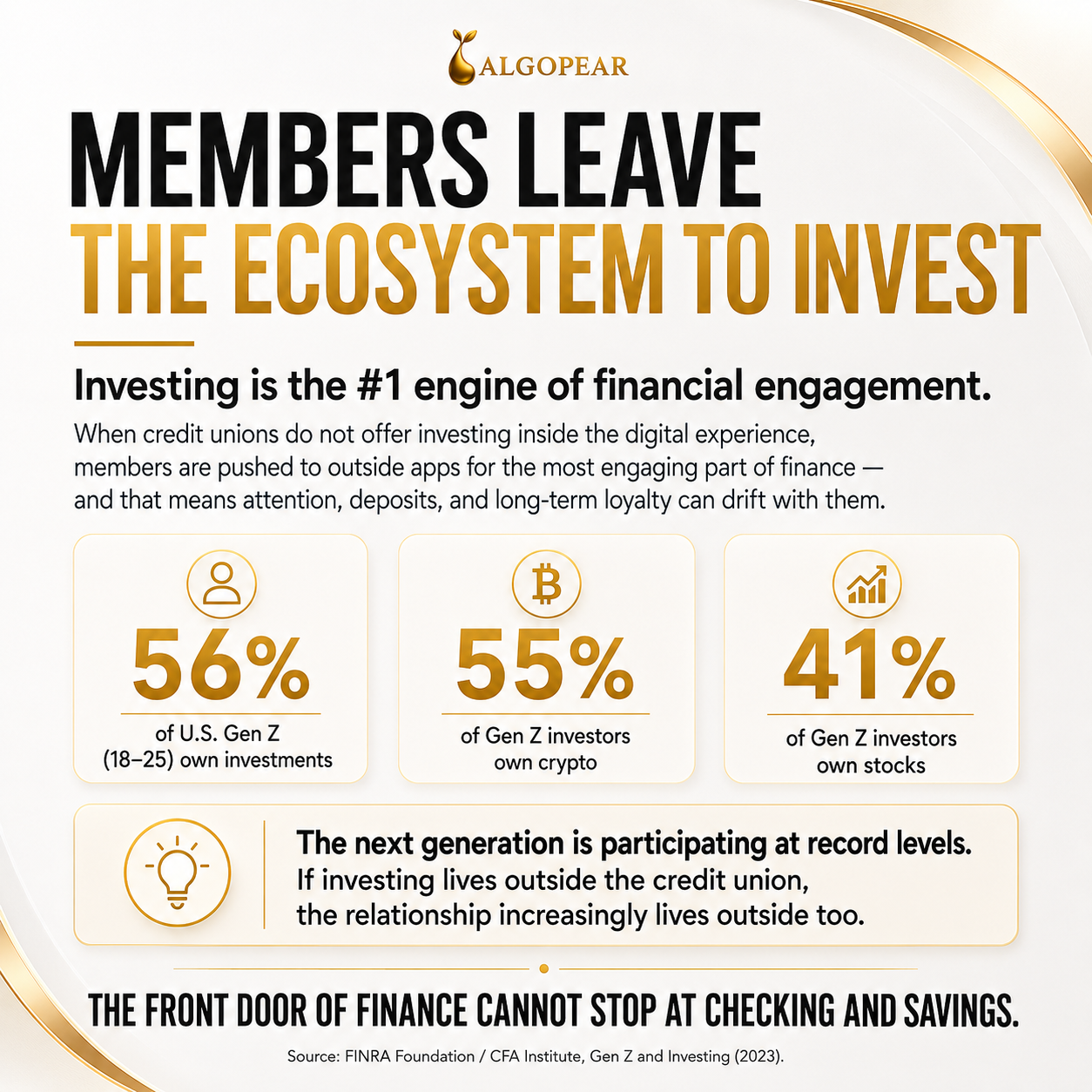
This matters because investing has moved from a specialized service into a primary engagement behavior. A younger member may not yet be ready for a mortgage, auto loan, or wealth advisor relationship, but they are already buying fractional shares, tracking market movement, following financial creators, and experimenting with digital assets. The World Economic Forum found that roughly 30% of Gen Z began investing by university age, compared with 15% of Millennials and only 5% of Baby Boomers at the same stage. That is a generational shift in when financial behavior begins — and it means the first serious financial relationship may no longer be a checking account or loan. It may be an investing platform.
For credit unions, this should change the strategic conversation. Investing is not merely an additional feature to consider someday. It is becoming a front-door relationship tool. The platform that helps a member invest early is also the platform that begins learning about that member’s goals, risk tolerance, liquidity, financial confidence, and future needs. If that platform is another fintech ecosystem, then the credit union is missing one of the earliest and most valuable signals of future financial growth.
Whoever Owns Investing Owns the Member’s Future Financial Data
Investing creates a data layer that is more valuable than many institutions realize. When a member invests, they reveal how they think about money. They reveal whether they are growth-oriented, conservative, speculative, long-term focused, short-term reactive, income-driven, or education-seeking. They reveal how often they contribute, how they respond to volatility, which asset classes interest them, and whether they are building financial confidence. This data is not just useful for investing. It becomes highly valuable for future lending, savings, insurance, financial guidance, and long-term relationship development.
Fintech platforms understand this. When Cash App allows a user to buy stocks with as little as $1, or when Binance gives eligible users access to thousands of U.S.-listed stocks and ETFs with fractional share investing starting at $5, the goal is not simply to process a stock trade. The goal is to deepen behavioral engagement. Every investment action gives the platform more insight into the user’s financial life. Over time, that insight can support more personalized recommendations, more relevant product offers, and more reasons for the user to keep money inside the platform.
This is where credit unions risk falling behind. If a member’s investing activity happens outside the credit union, the institution loses visibility into one of the clearest indicators of that member’s financial trajectory. It may still see deposits and payments, but it does not see wealth accumulation, portfolio behavior, risk appetite, or investment goals. That creates a major strategic disadvantage. In the next era of financial services, the institution with the best data will have the strongest ability to anticipate member needs. If fintech owns the investing data, fintech will be better positioned to influence the next financial decision.
Credit Unions Are Missing the Wealth-Building Moment
Most credit union digital ecosystems are still built around maintenance. Members can check balances, transfer funds, pay bills, deposit checks, manage cards, and apply for loans. These capabilities are important, but they are not enough to answer the next generation’s most urgent financial question: “How do I grow my money?” Younger members are not just looking for access to accounts. They are looking for progress. They want tools that help them invest, learn, plan, build confidence, and understand where their money can take them.
The gap becomes obvious when compared with fintech platforms. A Cash App user can receive money, spend money, buy Bitcoin, purchase stocks, automate investing, and build financial habits in one app. A Binance user can move between crypto markets and traditional equities access in one connected experience. A Coinbase user can hold digital assets, earn rewards, use stablecoins, and engage with crypto-native financial products. Meanwhile, many credit union members still cannot buy a single fractional share of Apple, an ETF, or a diversified investment product through the digital banking environment they already trust.
That gap matters because the wealth-building moment is emotionally powerful. When a member decides to invest, they are not simply moving money. They are expressing ambition. They are preparing for the future. They are trying to participate in wealth creation. If the credit union is absent during that moment, the member is forced to leave the ecosystem to act on one of the most important financial behaviors of their life. Once that behavior becomes routine somewhere else, the credit union becomes less central to the member’s financial identity.
Fintech Converts Investing Into Deeper Financial Relationships
Fintech platforms are not treating investing as a standalone product. They are using investing as a bridge into deeper financial ecosystems. A user may begin by buying a small amount of stock or crypto, but the platform can then introduce cards, direct deposit, rewards, savings, borrowing, merchant payments, subscriptions, financial education, and AI-powered insights. This is the power of ecosystem expansion. One behavior becomes the entry point for many others.
Cash App is a strong example. What began as a peer-to-peer payment tool has expanded into a broader financial platform with direct deposit, debit card functionality, Bitcoin, stock investing, lending, tax tools, and savings features. Coinbase is another example, moving from crypto exchange into custody, staking, stablecoins, payments, subscriptions, and broader digital asset infrastructure. Binance is now expanding beyond crypto by giving eligible users access to U.S. stocks and ETFs. The pattern is clear: fintech platforms start with a single use case, earn trust through convenience, and then expand into more of the user’s financial life.
For credit unions, the risk is that fintech platforms are building the member relationship from the growth side inward. Instead of starting with checking and later adding wealth, fintech starts with action, investing, payments, and engagement — then expands toward banking-like services. This reverses the traditional credit union advantage. If younger users first trust fintech with investing, then later use that same platform for direct deposit, spending, borrowing, and guidance, the credit union may never receive the chance to become the primary relationship. The investment account becomes the wedge, and the ecosystem becomes the moat.
The Lending Relationship Will Follow the Wealth Relationship
Credit unions have historically relied on lending as a major relationship driver. Auto loans, personal loans, credit cards, mortgages, and small business lending have long been central to member value and institutional economics. But the lending relationship of the future will be shaped by who understands the member’s financial life before the borrowing need appears. If fintech platforms own the member’s investing behavior, asset growth, cash flow signals, and engagement data, they may be better positioned to identify when that member is ready for credit.
This is why investing and lending can no longer be viewed separately. A member building an investment portfolio may eventually need a car loan, a home loan, a business loan, or liquidity against assets. The institution that has been helping them build wealth may naturally become the institution they trust when they are ready to borrow. The line is simple but critical: the institution that helps the member build wealth today will be the institution most likely to finance their future tomorrow.
For credit unions, this creates both urgency and opportunity. If they integrate wealth-building tools now, they can strengthen the future lending pipeline by staying close to the member’s financial progression. They can see goals earlier, offer guidance sooner, and support members before a major financial decision happens elsewhere. But if they wait, fintech platforms will continue capturing the data, habits, and trust that precede borrowing behavior. The lending relationship is no longer won only at the moment of application. It is shaped years earlier through engagement, education, and wealth-building access.
The Strategic Response: Build the Wealth Layer Now
The solution is not for credit unions to abandon their identity or become fintech companies. The solution is to add the missing wealth layer inside the trusted credit union ecosystem. Members should be able to save, spend, borrow, learn, invest, and receive guidance without being forced into a fragmented financial life across five or six separate platforms. The more complete the ecosystem becomes, the more likely the credit union is to retain engagement, deposits, data, and long-term member value.
This requires embedded investing, financial literacy, AI-powered insights, risk education, portfolio learning, savings-to-investing pathways, and personalized guidance. It also requires speed. Fintech platforms are moving fast, and the next generation is not waiting for traditional institutions to catch up. Credit unions do not need to build everything internally, but they do need to partner with infrastructure that allows them to deliver modern wealth-building experiences quickly, safely, and in alignment with their member-first mission.
AlgoPear is built for this moment. Through Selene Intelligence by AlgoPear, credit unions can begin moving from a transactional digital banking model to a next-generation financial engagement ecosystem. The goal is not just to help members access accounts. The goal is to help members build financial confidence, invest intelligently, understand risk, and grow within the credit union environment. The future of member engagement will belong to institutions that connect trust with action.
Subscribe to AlgoPear Pulse for weekly insights on fintech trends, credit union strategy, and the future of digital member engagement. Visit AlgoPear.com to see how forward-thinking institutions are building financial ecosystems designed for the next generation member.