.png)

Written By Ben Malena 💥
Chief Marketing Officer, AlgoPear
AlgoPear Pulse — Edition 59
The Financial Relationship Has Changed. Has Banking Changed With It?
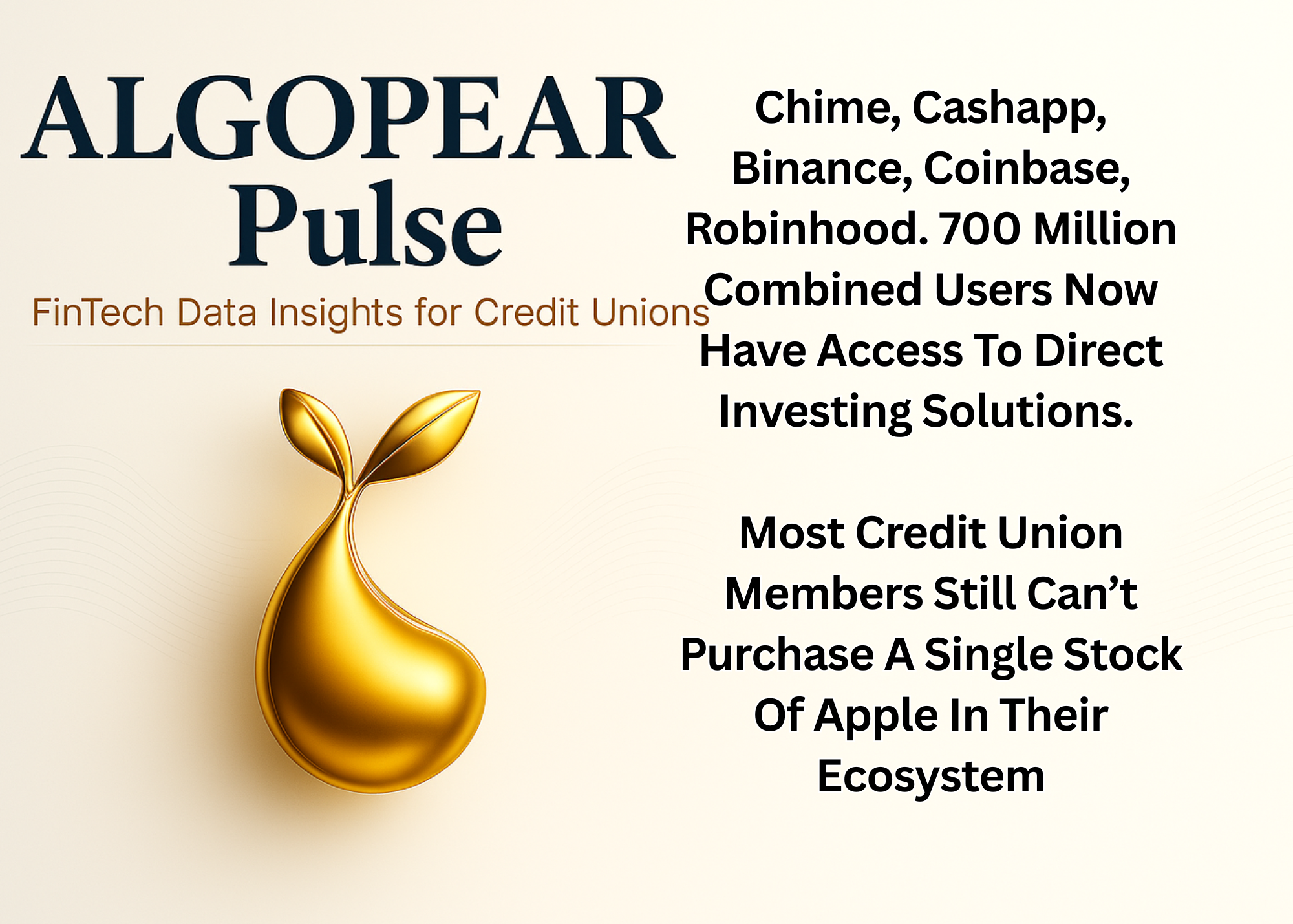
Over the past decade, the definition of a financial institution has quietly evolved. Consumers no longer expect their banking application to simply hold deposits, facilitate payments, or display account balances. Today’s largest financial platforms have expanded the relationship far beyond traditional banking by integrating investing, budgeting, financial education, cryptocurrency, savings automation, and personalized financial insights into one seamless digital experience. Whether through Chime, Cash App, Robinhood, Coinbase, Binance, PayPal, or other financial technology platforms, hundreds of millions of consumers around the world can now purchase investments with just a few taps on their mobile devices. For an entire generation of consumers, investing is no longer viewed as a specialized financial service—it has become an expected feature of modern money management.
This shift has fundamentally changed consumer expectations. Members increasingly expect their financial institution to help them build wealth, not simply safeguard the wealth they already have. They expect access to financial education, intelligent guidance, investing opportunities, and personalized recommendations without leaving the application they trust every day. The financial institution is gradually becoming a destination for ongoing financial progress rather than a place visited only when money needs to move. As engagement becomes more frequent, the institution becomes more valuable because it remains connected to every stage of the member’s financial journey.
Despite these changing expectations, many credit unions continue operating within a digital banking model designed for a different era. While members can check balances, transfer money, pay bills, and apply for loans, they often cannot perform one of the most important activities associated with long-term financial success—investing. Members who wish to purchase a single share of Apple, contribute toward an ETF, or begin building an investment portfolio frequently leave the credit union ecosystem entirely. The moment they decide to build wealth, another platform often becomes the center of that relationship.
The challenge is larger than missing an investment product. Every interaction that occurs outside the credit union represents engagement, behavioral insight, and relationship-building occurring somewhere else. As financial technology companies continue expanding their ecosystems, the competitive question is no longer whether investing belongs inside digital banking. The market has already answered that question. The real question is whether credit unions will remain central to their members’ financial lives—or simply continue supporting one portion of them.

Investing Is Not Just About Assets. It Is About Engagement.
Many conversations surrounding WealthTech focus on assets under management, portfolio balances, or investment revenue. While these metrics certainly matter, they represent only a fraction of the strategic opportunity. The true value of embedded investing is its ability to create continuous engagement. Unlike many traditional banking activities that occur only when money needs to move, investing encourages members to return repeatedly. They monitor market performance, make recurring contributions, review long-term goals, consume educational content, and interact with personalized financial insights. Every visit strengthens familiarity with the institution while reinforcing the habit of opening its application.
This consistent engagement produces something even more valuable than transactions—it generates first-party behavioral intelligence. Every investment contribution reflects financial discipline. Every recurring deposit demonstrates commitment toward future goals. Every educational article viewed reveals financial curiosity. Every interaction with budgeting tools, AI-powered guidance, or financial wellness resources provides additional context about where members are headed financially rather than simply where they have been. Collectively, these interactions create an evolving picture of financial behavior that traditional banking systems rarely capture.
Without embedded investing or broader WealthTech capabilities, much of this intelligence develops beyond the credit union’s visibility. Members invest elsewhere. They learn elsewhere. They receive financial coaching elsewhere. They establish wealth-building habits somewhere else. While the credit union continues managing checking accounts and servicing loans, another platform gradually becomes the institution most involved in helping members achieve their long-term financial goals. Over time, that relationship becomes increasingly difficult to replace because engagement—not transactions—is what creates loyalty.
Wealth Building Creates Lending Opportunities Long Before Loan Applications Exist
One of the greatest misconceptions within financial services is the belief that investing and lending operate independently of one another. In reality, they are often different stages of the same financial journey. Significant borrowing decisions rarely occur without months of preparation. Before purchasing a home, members typically increase savings, reduce revolving debt, improve cash flow, and demonstrate greater financial discipline. Before financing a vehicle, they often strengthen their credit profile or build confidence in their overall financial position. Before starting a business, they frequently accumulate capital and become more engaged with financial planning. These behavioral milestones emerge well before the first loan application is ever submitted.
Traditional lending models generally recognize members only after they enter the borrowing process. WealthTech extends that timeline dramatically by making financial preparation visible. Members actively engaged with investing, budgeting, financial education, savings automation, and AI-powered coaching continuously generate behavioral signals that indicate future financial needs. Rather than waiting for members to announce their intentions through an application, institutions gain the opportunity to recognize financial readiness months in advance.
This transforms lending from a reactive process into a proactive relationship. Mortgage education can reach members actively preparing for homeownership. Vehicle financing can be introduced as transportation savings increase. Credit card offers can be personalized based on improving financial health rather than broad demographic assumptions. Business lending conversations can begin as entrepreneurial financial behaviors emerge. Every recommendation becomes more relevant because it reflects actual financial progress instead of generalized marketing campaigns.
The result is a better experience for both the member and the institution. Members receive timely guidance when it provides the greatest value, while credit unions improve marketing efficiency, increase conversion opportunities, reduce acquisition costs, and deepen relationships through personalized financial support. Wealth building and lending no longer operate in separate departments—they become connected components of one intelligent financial ecosystem.
The Next Competitive Advantage Is Owning The Financial Ecosystem
For decades, financial institutions primarily competed through rates, branch convenience, and customer service. Digital banking introduced a new competitive dimension focused on convenience and mobile access. Today, another transformation is underway. Financial institutions increasingly compete based on the completeness of the financial ecosystem they provide.
Consumers are gravitating toward platforms capable of supporting every aspect of their financial lives within one connected experience. They want to save, spend, borrow, invest, learn, and receive personalized guidance without navigating multiple disconnected applications. The institution capable of becoming this financial operating system gains something far more valuable than product usage—it earns daily relevance.
Every time members leave their financial institution to invest elsewhere, another platform becomes more deeply embedded in their financial decision-making process. That platform gains engagement. It develops behavioral intelligence. It learns financial preferences. It understands long-term goals. It becomes the place members naturally return to whenever important financial decisions arise. Eventually, that engagement extends beyond investing into lending, insurance, payments, budgeting, retirement planning, and additional financial services.
This is why embedded investing represents a strategic initiative rather than simply another product offering. It strengthens the institution’s position within the member’s everyday financial life. It increases opportunities for education, engagement, personalization, and relationship development across multiple product categories. Most importantly, it enables credit unions to remain present throughout the financial journey instead of appearing only during isolated transactions.
The Future Of Banking Belongs To Institutions That Help Members Build Wealth
Perhaps the most significant opportunity facing credit unions is recognizing that modern consumers increasingly judge financial institutions not only by how well they manage money, but by how effectively they help members create wealth over time. The institutions that thrive over the next decade will be those capable of supporting every stage of financial progress—from opening a first checking account and building emergency savings to purchasing a first home, investing for retirement, launching a business, and transferring wealth to future generations.
Building this relationship requires more than introducing another digital feature. It requires creating an intelligent financial ecosystem where investing, financial wellness, budgeting, AI-powered guidance, education, savings, and lending work together to support the member continuously. Every interaction strengthens engagement. Every engagement produces behavioral intelligence. Every behavioral insight improves personalization. Every personalized experience deepens trust. Together, these relationships create a cycle of long-term member value that extends far beyond individual financial products.
Technology has made this transformation increasingly achievable. Open APIs, embedded finance, cloud-native infrastructure, artificial intelligence, and strategic fintech partnerships now allow credit unions to deliver sophisticated WealthTech experiences without building every capability internally. The challenge is no longer technological feasibility. It is strategic vision. Institutions that embrace this evolution will strengthen member loyalty while positioning themselves to compete in a financial marketplace increasingly defined by engagement rather than transactions.
Conclusion
Consumers have already embraced embedded investing. The expectation that financial institutions should help members build wealth is no longer emerging—it has arrived. Every day, millions of people open financial applications not only to move money but to invest, learn, budget, plan, and prepare for future financial milestones. Those daily interactions generate engagement, and engagement creates the behavioral intelligence that powers stronger financial relationships.
For credit unions, this represents an extraordinary opportunity. Embedded investing is not simply another product to add to a digital banking platform. It is an engagement engine capable of strengthening member loyalty, increasing first-party financial intelligence, improving lending opportunities, enhancing financial wellness, and creating deeper lifetime relationships. Institutions that continue viewing investing as separate from everyday banking risk allowing other platforms to own the most valuable moments of their members’ financial lives.
At AlgoPear, we believe the future belongs to intelligent financial ecosystems where investing, AI-powered guidance, financial wellness, budgeting, education, and lending work together as one connected member experience. Through Selene Intelligence, credit unions can transform everyday financial engagement into meaningful behavioral intelligence that supports more personalized lending, stronger member relationships, and sustainable institutional growth.
The next generation of banking will not be defined by who offers the lowest rates or the fastest transactions. It will be defined by which institutions become the trusted partner members rely on every day to build wealth, achieve financial confidence, and reach life’s most important milestones. Credit unions have spent decades helping members borrow responsibly. The next decade presents an equally important opportunity—to help them build wealth just as successfully.
Subscribe to AlgoPear Pulse
The future of credit union innovation extends far beyond digital banking. WealthTech, artificial intelligence, embedded finance, financial wellness, and intelligent member engagement are reshaping how institutions build lasting relationships and sustainable growth.
Subscribe to the AlgoPear Pulse Newsletter for weekly executive insights on the trends transforming credit unions, fintech partnerships, lending innovation, AI, WealthTech, and the future of member engagement.
Visit AlgoPear.com to learn how AlgoPear and Selene Intelligence are helping credit unions build intelligent financial ecosystems that increase engagement, strengthen lending, and empower the next generation of members.