.png)

Author: Ben Malena CMO, AlgoPear
AlgoPear Edition: AlgoPear Pulse — Edition 58
Date: July 16, 2026
Financial institutions have traditionally treated investing, deposits, lending, and financial education as separate areas of the member relationship. A member may keep a checking account at a credit union, invest through an outside fintech platform, use another provider for financial guidance, and eventually seek financing from a completely different institution. That fragmentation creates a significant strategic challenge. Even when a financial institution retains the member’s primary account, it may still lose the member’s attention, investment activity, financial data, and future product demand to outside platforms that are more closely connected to the member’s daily financial decisions.
Embedded InvestTech offers a different operating model. By placing wealth-building capabilities directly inside the institution’s digital experience, investing becomes more than an additional product added to online banking. It becomes a recurring engagement channel that can help the institution remain involved as members save, invest, build confidence, evaluate goals, and prepare for larger financial decisions. When implemented effectively, embedded investing can strengthen member relationships, retain financial activity, reveal meaningful behavioral signals, and create more relevant opportunities for deposits, loans, credit products, and long-term relationship growth.
The Selene Intelligence Wealth Engagement Pilot examined how members progressed through this journey, beginning with an invitation and continuing through activation, profile completion, account funding, first investment, and recurring usage. The findings suggest that the effectiveness of embedded InvestTech should not be measured only by the number of members who purchase an investment product. Its larger value may come from the behavioral progression it creates and the additional insight that progression provides to the financial institution.
The Investment Journey Begins With the Invitation
The effectiveness of an embedded financial experience should be evaluated across the entire member journey rather than only at the final transaction. Each step—from opening the invitation to completing a profile and funding an account—represents a deeper level of interest, trust, and financial intent. This is especially important for financial institutions because broad marketing campaigns often generate impressions and clicks without revealing which members are prepared to take meaningful action. An embedded experience creates a clearer pathway from initial curiosity to measurable financial behavior.
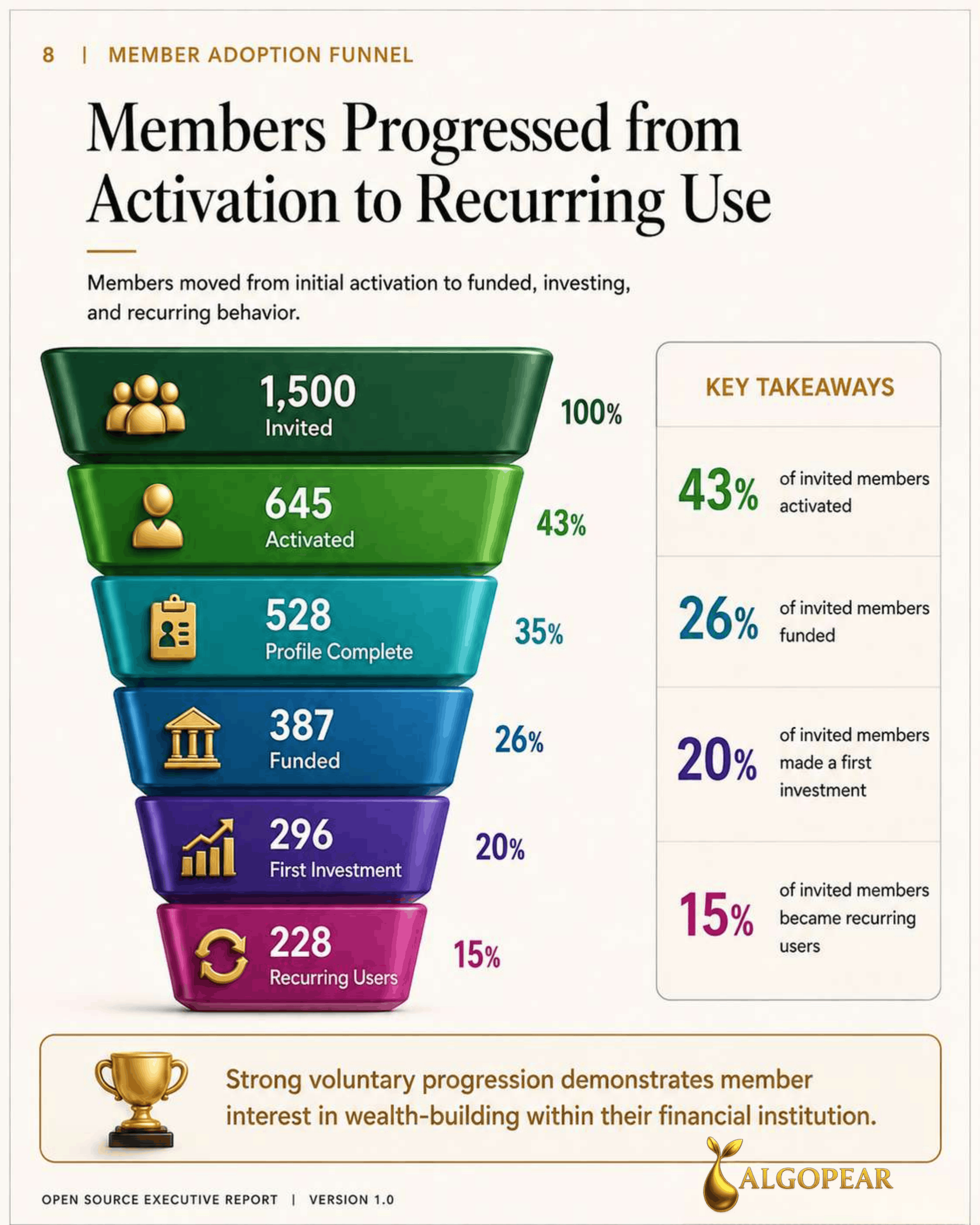
The Selene pilot began with 1,500 invited members. Of that group, 645 activated the experience, 528 completed their profiles, 387 funded an account, 296 made an initial investment, and 228 developed recurring usage. This represented a 43 percent invitation-to-activation rate, a 26 percent funding rate across the full invited cohort, a 20 percent investment rate, and a 15 percent recurring-user rate. These figures demonstrate that the member journey did not end with interest. A significant portion of participants continued progressing through increasingly meaningful stages of commitment.
Each stage provided the financial institution with a stronger signal. Opening an invitation suggested curiosity. Activating the experience demonstrated interest. Completing a profile required greater trust and effort. Funding an account showed financial commitment. Making an investment indicated action, while recurring usage suggested the beginning of an ongoing habit. This progression allows a financial institution to distinguish between members who simply viewed a message and members who are actively building toward a financial objective.
Embedded Investing Creates Recurring Engagement
Many traditional digital banking interactions are brief, necessary, and transactional. A member may log in to review a balance, confirm a deposit, pay a bill, transfer funds, or verify that a payment has cleared. Although these activities are essential to the banking relationship, they often provide limited opportunities for deeper engagement. The member enters the application to complete a task and then leaves without spending meaningful time exploring additional services or considering broader financial goals.
Investing creates a different pattern of interaction because it is connected to progress, planning, and long-term decision-making. Members may return to review performance, monitor contributions, study educational content, assess financial goals, or determine whether they are prepared to invest additional funds. Each visit gives the institution another opportunity to provide value and become more relevant to the member’s financial life. Over time, the experience can shift the digital relationship from simple account servicing toward ongoing financial participation.
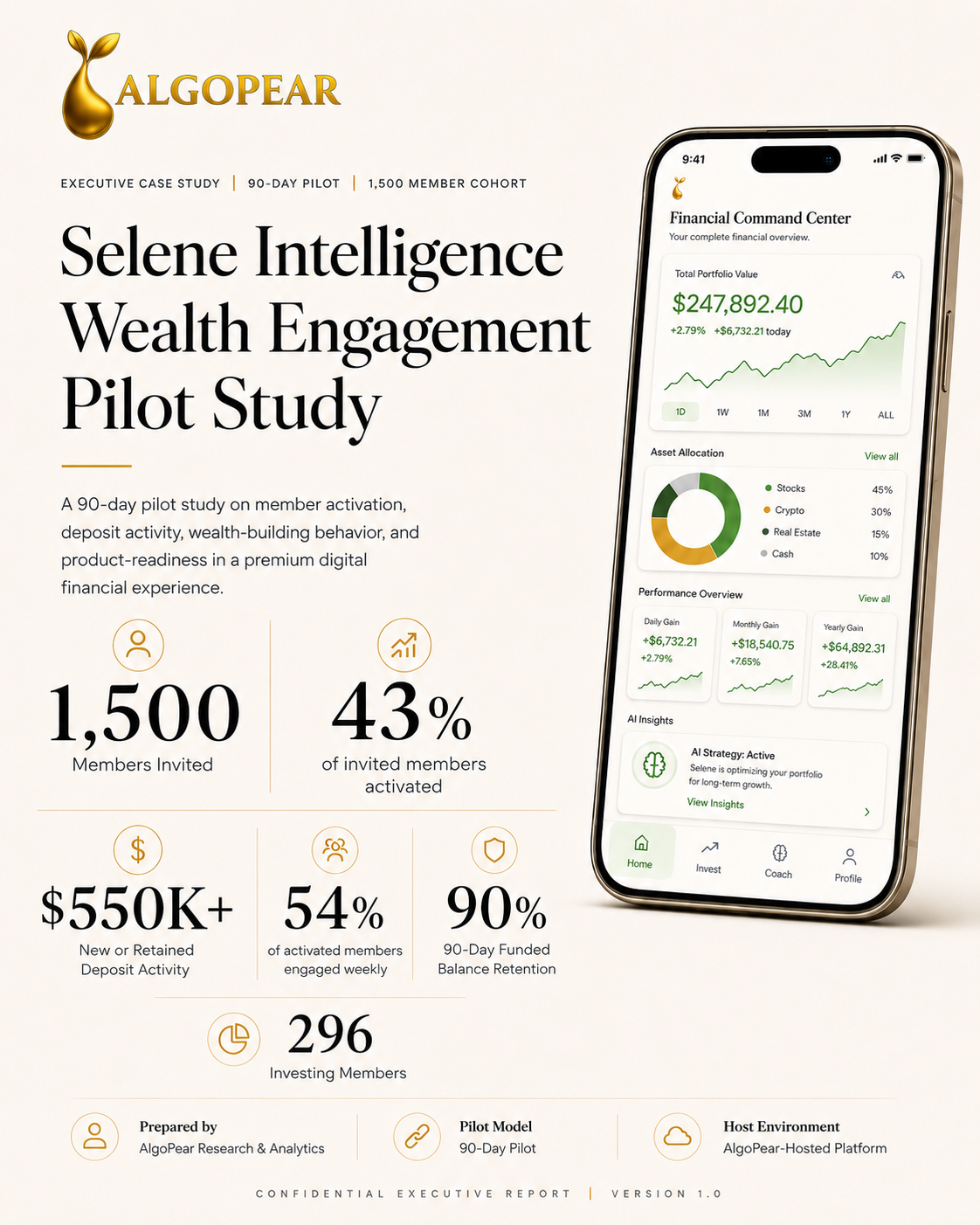
During the pilot, 54 percent of activated members engaged weekly. Members averaged 4.6 weekly sessions, with an average session duration of 7.8 minutes. Engagement also increased over the course of the program, rising from 38 percent in week two to 71 percent by week twelve. This upward trend is important because it suggests that the experience became more useful as members became familiar with it. Rather than engagement declining after the initial launch, members increasingly returned to the platform as the pilot progressed.
Digital relationship value is now shaped by frequency, relevance, and usefulness. The institution that helps a member build toward an investment objective has an opportunity to become more than the place where transactions are processed. It can become part of the member’s ongoing financial decision-making process. That deeper role may ultimately influence where the member saves, borrows, invests, and seeks financial guidance in the future.
Retention Is the Bridge to a Deeper Relationship
Product activation is only the first stage of the relationship. A large number of financial applications can generate initial attention through marketing, novelty, or incentives, but the stronger measure of value is whether members continue engaging after the initial experience has passed. Retention demonstrates that the product remains useful and that the member sees enough value to continue returning, maintaining balances, and building financial habits over time.
The pilot recorded 228 recurring users, representing 35 percent of activated members and 15 percent of the full invited cohort. It also reported 90 percent funded-balance retention over the 90-day period. These results indicate that a meaningful portion of participating members did not treat the experience as a one-time promotion. They continued returning to the platform, retained funds within the experience, and showed signs of developing a longer-term relationship with the product.
This continuity can strengthen the overall relationship between the member and the financial institution. A member who repeatedly engages with an investment experience, maintains a balance, and continues contributing toward a financial objective is demonstrating trust, discipline, and intent. Those behaviors can provide a more complete understanding of the member than a traditional account balance or transaction history alone.
Retention should therefore not be treated as the final stage of the product funnel. It is the bridge between initial adoption and broader relationship expansion. Once a member develops a recurring financial habit within the institution’s ecosystem, the institution is better positioned to support additional goals and introduce relevant products at the appropriate time.
Embedded InvestTech Can Help Retain Financial Activity
Financial institutions have often viewed investment platforms as destinations that pull deposits and engagement away from the core banking relationship. When members move funds to an outside brokerage, robo-advisor, or wealth application, the institution may lose visibility into both the assets and the behavior surrounding those assets. It may no longer know why the member moved the money, what objective the member is pursuing, or what financial need may emerge next.
Embedded investing can change that dynamic by keeping the wealth-building experience connected to the institution’s digital ecosystem. Instead of forcing members to leave the institution to begin investing, the financial institution can provide a more unified experience in which banking, investing, education, and financial guidance operate together. This allows the institution to remain involved as members move from cash accumulation to investment activity and from short-term financial management to long-term planning.
The Selene pilot reported more than $550,000 in new or retained financial activity. This included approximately $418,000 in invested or portfolio assets, $72,000 in checking and savings activity, $38,000 in cash awaiting investment, and $22,000 in the recurring-transfer pipeline. The value of this activity is not limited to the amount invested. It also includes the surrounding balances, transfers, and recurring behaviors that remained visible within the institution’s ecosystem.
That visibility creates strategic value. The institution can observe when members fund accounts, retain liquidity, activate recurring contributions, and move from passive savings toward active wealth building. Instead of losing the entire investment relationship to an outside provider, the institution can remain connected to the member’s broader financial journey and identify additional opportunities to provide support.
Investment Behavior Creates Product-Ready Signals
The most significant institutional value may emerge from what investment behavior reveals about the member. Financial institutions have historically relied on broad eligibility criteria, account ownership, credit profiles, and demographic information to determine which products to promote. While those methods remain useful, they may not fully reflect what the member is actively trying to accomplish or when the member is prepared to consider another financial product.
Embedded InvestTech can create more contextual and timely signals. A member who contributes consistently may be demonstrating financial discipline and available cash flow. A member who selects a home-related objective may eventually show mortgage readiness. A member who maintains liquidity while increasing investments may have the capacity for an additional savings product, credit card, or loan. A member who repeatedly engages with personalized financial guidance may also be more receptive to a recommendation that supports an existing goal.
The case study identified potential signals related to borrowing readiness, auto-loan interest, credit-card interest, home-loan readiness, and broader cross-sell opportunities. These signals should not be treated as automatic approval decisions or immediate sales triggers. Instead, they can help the institution better understand the member’s financial direction and determine whether a relevant conversation or offer may be appropriate.
The investment journey can therefore become an early indicator of future financial demand. By observing how members save, fund, invest, and return, the institution can develop a clearer view of what the member may need next and when that need may become actionable.
Cross-Selling Becomes More Relevant When It Follows Member Intent
Traditional cross-selling often begins with the institution’s product objective. The institution may want to increase auto-loan originations, credit-card adoption, mortgage applications, or deposit balances. Marketing campaigns are then created around those institutional priorities, and members receive offers based on broad segmentation or eligibility criteria. Although this approach can produce results, it may feel disconnected from the member’s current financial priorities.
Embedded engagement allows the relationship to begin with the member’s objective instead. The member may be building emergency savings, making a first investment, automating contributions, preparing for a home purchase, or trying to establish greater financial stability. By observing that journey, the institution can better understand the member before introducing another product. The recommendation becomes more relevant because it is connected to something the member has already demonstrated through behavior.
The sequence becomes more natural. The institution invites the member into a useful experience, helps the member activate, supports funding and investing, encourages recurring engagement, identifies financial intent, and then presents an appropriate product when the timing makes sense. This can reduce the gap between marketing and member need because the offer is grounded in the member’s existing financial journey.
Cross-selling becomes less about interruption and more about extending the relationship. Instead of presenting unrelated products, the institution can connect lending, savings, and credit opportunities to the goals the member is already pursuing. That approach has the potential to improve relevance, strengthen trust, and create better long-term outcomes for both the member and the institution.
Engaged Members Can Become More Valuable Members
The case study projected meaningful institutional opportunity from the behaviors observed during the pilot. It identified 296 members demonstrating investment behavior, more than $2.7 million in estimated annual product-revenue opportunity, more than $5.6 million in projected deposit-growth potential, and a projected 3.2-times increase in long-term member value compared with non-engaged members.
These figures represent modeled opportunities based on pilot behavior rather than revenue or deposit growth already realized. That distinction is important because projected value should be communicated transparently. However, the underlying strategic implication remains significant. Members who engage more frequently, maintain balances, establish recurring financial habits, and demonstrate clear intent may provide the institution with more opportunities to deepen the relationship over time.
The value of embedded InvestTech should not be judged solely by investment-related revenue. Its larger potential may come from creating more engaged, visible, and product-ready member relationships. Investment activity can become the entry point into a broader relationship that includes deposits, lending, financial education, and personalized guidance.
When members interact more frequently and reveal more about their financial priorities, the institution gains a stronger foundation for retention, personalization, and long-term growth. This is what turns embedded InvestTech from a standalone feature into a strategic relationship channel.
Financial Institutions Need More Than Another Feature
Adding an investment button to a digital banking application is not enough to create these outcomes. A successful embedded InvestTech strategy requires a coordinated experience that supports the member from the first invitation through recurring engagement. The product must be easy to discover, simple to activate, understandable to new investors, and connected to the institution’s broader digital strategy.
The experience should include a clear invitation journey, simple onboarding, personalized guidance, educational support, easy funding, recurring-contribution capabilities, and ongoing behavioral measurement. It should also be integrated with deposit, lending, and member-engagement strategies so that the institution can respond appropriately as members progress through different stages of financial readiness.
Appropriate governance, disclosures, member consent, data controls, and compliance oversight must remain central to the experience. Behavioral insight should be used responsibly, and members should understand how their information supports personalization and product recommendations. Trust is essential because the institution is not simply offering another digital feature; it is asking members to bring more of their financial lives into a connected ecosystem.
When these elements operate together, embedded investing becomes more than a standalone product. It becomes relationship infrastructure that can support engagement, retention, deposits, lending, and long-term member value.
From Investment Engagement to Institutional Growth
The Selene Intelligence pilot suggests that members will voluntarily engage with a wealth-building experience delivered within a trusted financial environment. Some members will activate. Some will complete their profiles and fund accounts. Others will make an initial investment and continue returning until the experience becomes part of their regular financial behavior.
As that journey develops, the institution gains more than investment adoption. It gains greater visibility into member intent, financial capacity, savings patterns, long-term objectives, and potential future product needs. That insight can support more relevant communication and help the institution determine where it can provide additional value.
This is where embedded InvestTech becomes strategically important. It can connect the institution to financial decisions that may otherwise occur outside the traditional banking relationship. By helping members build wealth inside the institution’s ecosystem, the institution can remain present as members prepare for future purchases, borrowing needs, and financial milestones.
The opportunity is not simply to help a member make an investment. It is to remain present as that member makes the next financial decision.
Selene Intelligence by AlgoPear is designed to help financial institutions embed intelligent wealth-building experiences directly into their digital environments. By connecting member engagement, investment behavior, personalized guidance, and product-ready signals, Selene can help institutions turn financial wellness into measurable relationship growth.
Subscribe to AlgoPear Pulse
AlgoPear Pulse delivers executive insights on embedded finance, agentic banking, digital engagement, lending innovation, and the technologies reshaping financial institution growth. Each edition examines the market shifts, member behaviors, and strategic opportunities that credit union and financial institution leaders should understand as the industry continues to evolve.
Subscribe to AlgoPear Pulse for new research, case studies, executive perspectives, and strategic analysis from AlgoPear.