.png)


CREDIT UNION MEMBERS WANT ACCESS TO DIRECT INVESTING NOW
Why Are Members Still Forced to Leave the Credit Union Ecosystem to Build Wealth?
Written By Ben Malena CMO AlgoPear Edition 53
The Rise of the Self-Directed Investor
A fundamental shift is occurring in the financial lives of American consumers. For decades, investing was often viewed as a specialized activity reserved for affluent households, experienced market participants, or individuals working closely with financial advisors. Participation in financial markets required higher account minimums, greater financial knowledge, and access to institutions that were often intimidating to the average consumer. Today, those barriers have largely disappeared. Investing has become mainstream, accessible, and increasingly viewed as a normal component of everyday financial life.
The data reflects this transformation. Retail investors now account for approximately 20% to 25% of daily U.S. equity trading volume, a dramatic increase from historical levels. Commission-free trading, fractional share ownership, mobile-first investing experiences, and real-time financial education have opened the market to millions of new participants. What was once considered an advanced financial activity has become a common financial behavior. The rise of platforms focused on investing and wealth-building has fundamentally changed who participates in financial markets and how often they engage.
This shift is especially pronounced among Millennials and Generation Z. Studies consistently show younger generations begin investing earlier than previous generations and are significantly more likely to use digital platforms as their primary entry point into financial markets. Many younger consumers view investing as equally important as maintaining a checking account or emergency fund. Building wealth is no longer something delegated entirely to institutions or advisors—it is something they expect to participate in directly.
Perhaps most importantly, investing has evolved beyond a financial product and become a financial behavior. Consumers are not simply seeking access to markets; they are seeking opportunities to learn, grow, and take control of their financial futures. As investing becomes increasingly integrated into daily financial life, member expectations are changing. Consumers no longer view wealth-building as a separate journey from banking. They increasingly expect their primary financial institution to play a role in helping them grow their money—not simply hold it.
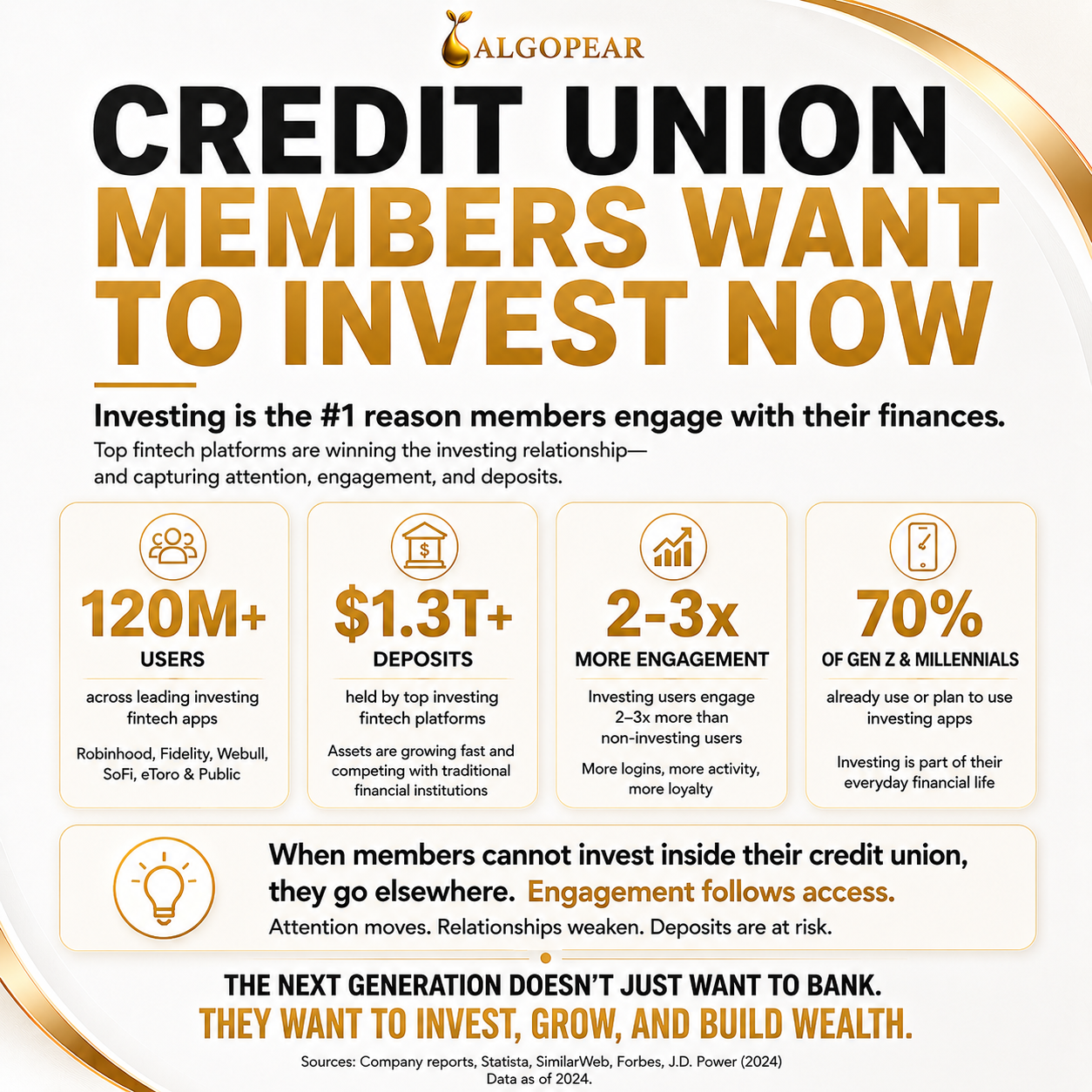
Members Want Wealth-Building, Not Just Banking
For generations, financial institutions have been extraordinarily effective at helping consumers manage and protect their money. Checking accounts, savings accounts, debit cards, and lending products remain foundational components of the financial system. However, the expectations of modern consumers have expanded beyond maintenance-first financial services. Today’s members want tools that help them move forward financially, not simply manage where they are today.
The distinction between maintaining money and growing money is becoming increasingly important. Inflation, housing affordability challenges, student debt obligations, and retirement concerns have changed how consumers think about financial security. According to numerous consumer finance studies, younger generations are more likely to prioritize wealth-building and investment access than previous generations at similar stages of life. Simply preserving capital is no longer viewed as sufficient. Consumers increasingly want opportunities to grow it.
This is particularly true among Millennials and Generation Z who understand that long-term financial security increasingly depends on participation in capital markets. They are consuming financial content daily, discussing investing with peers, and actively searching for opportunities to put their money to work. Financial growth is no longer viewed as a luxury activity reserved for affluent households. It has become an expected component of personal financial management.
As a result, many consumers are beginning to evaluate financial institutions through a different lens. They are not simply asking whether a financial institution can hold their money. They are asking whether that institution can help them grow it. This shift in expectations is creating new competitive pressures across the financial services landscape and forcing institutions to rethink what the modern financial relationship should include.
Why Members Leave the Credit Union Ecosystem to Invest
One of the most significant challenges facing credit unions today is that many members are already investing—they are simply doing it somewhere else. While credit unions continue to maintain trusted relationships and hold deposits, the actual wealth-building journey often takes place outside of the institution’s ecosystem. This creates a growing disconnect between where members store their money and where they engage with it.
The average consumer now maintains relationships with multiple financial providers simultaneously. Research across the financial services industry indicates that younger consumers often use between five and ten financial applications to manage various aspects of their financial lives. A member may use a credit union for checking and savings, another platform for investing, another application for retirement planning, another provider for cryptocurrency, and yet another platform for budgeting and financial education.
This fragmentation has consequences that extend far beyond convenience. The platforms where consumers learn, invest, monitor progress, and make financial decisions often become the platforms where engagement and loyalty are built. Those platforms collect behavioral insights, establish recurring interactions, and become increasingly influential in the consumer’s financial journey. Over time, the institution that helps members grow wealth often becomes more relevant than the institution that simply stores deposits.
The result is a quiet migration of financial engagement. Deposits may remain within the credit union, but the activities driving daily interaction, financial confidence, and long-term wealth creation increasingly occur elsewhere. As this trend accelerates, credit unions risk becoming the place where money sits rather than the place where financial futures are built.
Big Banks Have Already Made Their Decision
The direct investing conversation is no longer theoretical. Large financial institutions have already made substantial investments in wealth-building platforms because they recognize the behavioral shift occurring among consumers. Across the banking industry, investing is increasingly being integrated into the primary financial relationship rather than treated as a separate service.
Major institutions understand that investing generates engagement. Members who actively monitor portfolios, contribute to investments, and participate in markets interact with financial platforms far more frequently than members who only conduct transactional banking activities. Increased engagement creates more opportunities to strengthen relationships, deliver value, and deepen the overall financial relationship.
The broader financial industry has also recognized that the line separating banking and investing is rapidly disappearing. Consumers do not think about their finances in organizational silos. They simply want access to tools that help them manage, grow, and understand their money. Institutions that successfully integrate these experiences create more comprehensive and relevant financial relationships.
As investment participation continues to rise across all demographics, direct investing is becoming less of a specialized offering and more of a core financial expectation. Institutions that acknowledge this reality are positioning themselves for the future. Those that do not may find themselves competing against platforms that are increasingly capturing the attention, engagement, and loyalty of the next generation.
The Future Financial Relationship Includes Investing
The financial relationship of the future will look fundamentally different from the financial relationship of the past. Traditional banking products will remain important, but they will no longer define the entire member experience. Consumers increasingly expect their financial institution to provide access to the full spectrum of financial wellness, including education, planning, wealth-building, and investment participation.
The timing of this shift is significant. Analysts estimate that more than $80 trillion of wealth is expected to transfer from Baby Boomers to younger generations over the next two decades. The institutions that establish trusted relationships with future asset holders will be uniquely positioned to participate in this historic transfer of wealth and influence.
The rise of direct investing reflects a broader shift from maintenance-first finance to growth-first finance. Consumers are no longer satisfied with simply managing money. They want to understand it, optimize it, and grow it. Financial institutions that recognize this shift have an opportunity to become more deeply embedded in the financial lives of their members.
The question is no longer whether members want access to investing. The market has already answered that question. Millions of consumers are actively participating in financial markets, building portfolios, and seeking opportunities to grow wealth. The real question facing the industry is whether that activity will continue occurring outside the credit union ecosystem—or whether the next generation of financial experiences will evolve to support the complete financial journey.
The Future of Member Engagement Will Be Built Around Wealth
Direct investing is no longer a niche offering. It is becoming a core component of how consumers think about financial wellness, financial growth, and long-term financial security. As retail participation continues to rise and wealth-building becomes more central to financial behavior, institutions across the industry will be forced to evaluate how they support these evolving expectations.
For credit unions, this conversation is larger than investing alone. It is about engagement, relevance, and the future role of the institution in a member’s financial life. The organizations that successfully connect banking, education, investing, and wealth-building into a cohesive experience will be positioned to strengthen relationships and deepen member engagement for years to come.
The institutions that win the next decade will not simply be the institutions that hold deposits. They will be the institutions that help members achieve outcomes. They will be the institutions that educate, guide, and empower consumers throughout their wealth-building journey. In an environment where investing has become mainstream and financial participation is accelerating, remaining absent from that journey becomes increasingly difficult to justify.
Thank you for reading AlgoPear Pulse.
Subscribe to the AlgoPear Pulse Newsletter for executive insights on fintech innovation, digital banking transformation, wealth-building trends, and the future of credit union engagement.
Visit www.algopear.com to learn more about the future of financial ecosystems, embedded investing, and next-generation member experiences.