.png)

Written By Ben Malena 💥
Chief Marketing Officer, AlgoPear
AlgoPear Pulse Newsletter — Edition 60
The Financial Industry Is Following the Engagement
For years, investing existed outside the everyday banking relationship. Consumers deposited income with one institution, maintained checking and savings accounts there, and transferred money to a separate brokerage whenever they wanted to participate in the markets. That separation once reflected the complexity of brokerage infrastructure, custody, compliance, and digital integration. Today, those barriers are steadily being reduced. Embedded finance, modern APIs, fractional investing, digital identity systems, and faster money movement have made it possible for wealth-building experiences to exist inside the same applications consumers use to send money, monitor spending, and manage their financial lives. The result is a fundamental shift in expectations: investing is no longer viewed exclusively as a specialized brokerage service. It is increasingly becoming a standard component of the modern financial ecosystem.
The largest fintech platforms did not embrace investing simply because they wanted to add another product. They followed the engagement. Investment experiences create recurring reasons for consumers to return: portfolio values change, companies release earnings, markets react to economic developments, and members continue making contributions toward long-term goals. Each interaction creates another opportunity to deliver education, personalized guidance, savings tools, financial products, and relevant content. What begins with the purchase of a fractional share can gradually become a daily financial habit. That habit gives the platform something far more valuable than a single transaction—it gives the platform attention, behavioral context, and a growing position within the consumer’s financial life.
Visa’s expansion into embedded money movement provides another signal that financial infrastructure is adapting to this shift. Visa Direct supports experiences that include funding digital wallets, managing brokerage applications, and moving money within existing digital platforms. Visa is not presenting itself as a traditional consumer brokerage, but its infrastructure is helping make investment and fintech experiences easier to fund, connect, and scale. The distinction matters, yet the strategic message remains powerful: one of the world’s largest payment networks is helping remove friction between deposits, wallets, brokerage applications, and digital financial services because this is where consumer activity is moving. The industry is building around engagement. Credit unions must now determine whether they will build around it as well.
The Primary Financial Relationship Is No Longer Defined by the Checking Account
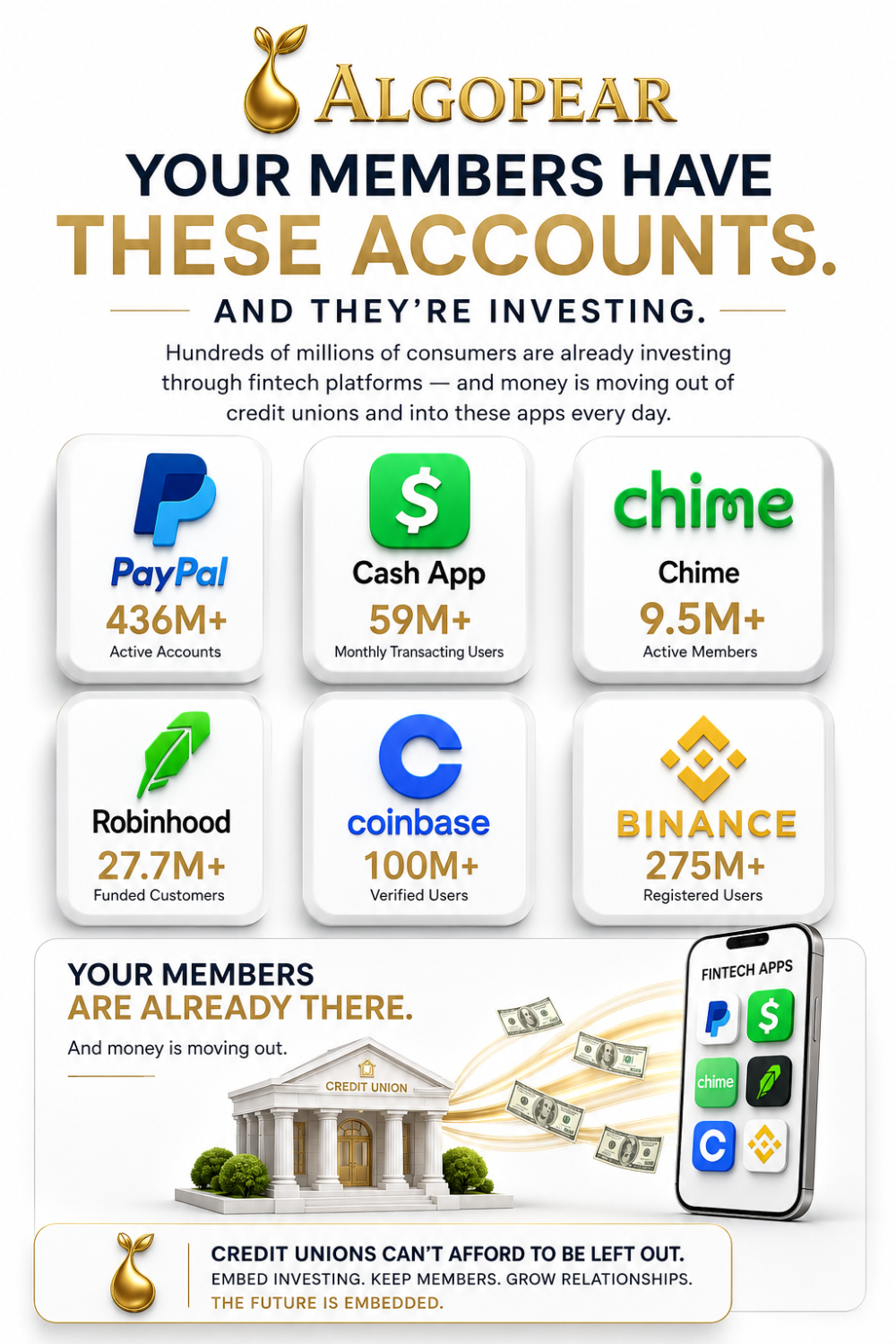
For generations, the primary financial institution was generally the organization receiving the member’s direct deposit, maintaining the checking account, issuing the debit card, and providing access to loans. That definition worked when most financial activity occurred through branches, cards, and traditional banking channels. The digital economy has changed the relationship. A member may still deposit income into a credit union account while spending considerably more time inside another application monitoring investments, reading financial content, discussing markets, tracking goals, and receiving personalized recommendations. The credit union may hold the money, but the outside platform increasingly owns the member’s attention.
This distinction matters because attention shapes financial behavior. The application members open most frequently becomes the environment where they develop confidence, explore new ideas, and prepare for future decisions. An investment platform may begin by helping someone purchase a small amount of stock, but that interaction can expand into automated contributions, cash management, retirement planning, payment services, credit products, and financial education. The platform does not need to replace the credit union immediately. It only needs to become more relevant one interaction at a time. Over several years, that repeated engagement can create a deeper emotional and behavioral relationship than the institution still processing the member’s paycheck.
Credit unions therefore are not simply competing against another bank or credit union. They are competing against every digital platform attempting to become the member’s financial operating system. Fintech applications are combining spending, saving, investing, borrowing, payments, and financial guidance because connected experiences generate more engagement and increase the value of the entire ecosystem. Credit unions retain powerful advantages—trust, lending expertise, established deposits, community credibility, and longstanding member relationships—but those advantages become less decisive when the institution disappears at the exact moment members begin building wealth. The executive question is no longer whether investing belongs in digital banking. It is whether the credit union can remain the primary financial relationship when members must leave its ecosystem to pursue one of their most important financial goals.
Deposits Are Leaving, but the Larger Loss Is Behavioral Intelligence
Every external investment account must be funded, and much of that money begins inside a traditional bank or credit union account. One member may transfer $25 each week into a brokerage application. Another may redirect several hundred dollars from each paycheck toward stocks, exchange-traded funds, digital assets, or retirement products. A more established investor may gradually move thousands of dollars into an outside wealth platform. These transfers are not necessarily alarming when viewed individually, but together they represent a sustained movement of deposits and financial activity into ecosystems designed to capture a larger share of the consumer relationship.
The problem is not that members are investing. Responsible wealth building is completely aligned with the credit union mission. The problem is that the institution is frequently excluded from everything that happens after the transfer. The credit union sees money leaving the account, but the outside platform sees the purpose behind the movement. It can observe whether the member is creating a recurring investment habit, preparing for retirement, building a down payment, exploring a particular industry, or reacting to market volatility. It can then use that understanding to personalize education, recommend additional services, and become more deeply involved in future financial decisions.
This creates an expanding information disadvantage. Traditional banking data explains what has already occurred: a deposit arrived, a bill was paid, a balance changed, or money was transferred. Engagement data adds context about what the member may be trying to accomplish next. As artificial intelligence and personalization become more important, that context becomes increasingly valuable. The institution that understands financial goals, interests, and momentum can communicate more intelligently and identify emerging needs earlier. Credit unions may continue processing the transaction while another platform develops the intelligence required to influence the next loan, retirement account, insurance decision, or major purchase. Every dollar leaving the ecosystem therefore carries more than funds. It can also carry attention, intent, and future opportunity.
Investing Is Becoming a Social, Educational, and Cultural Experience
Modern investing platforms are no longer simply transaction tools. They have become environments where consumers learn about companies, follow market developments, watch financial content, participate in conversations, create watchlists, compare strategies, and celebrate milestones. For many younger consumers, purchasing a first fractional share represents participation in the economy and the beginning of a personal wealth-building journey. The amount invested may be modest, but the sense of progress can be meaningful. That emotional connection is one reason investing generates a level of engagement that traditional banking activities often struggle to create.
Financial platforms understand this behavior and design around it. Notifications invite users to monitor market activity. Educational content explains unfamiliar concepts. Automated contributions reinforce consistency. Social discussions create curiosity, while visible portfolio progress encourages people to return. These experiences can influence saving, budgeting, and spending behavior far beyond the investment account itself. A member who becomes excited about building a portfolio may begin reducing unnecessary expenses, increasing savings, or learning more about long-term financial planning. Investing can therefore become an entry point into a much broader financial wellness relationship.
Credit unions have an opportunity to create a more responsible and mission-aligned version of this experience. Rather than encouraging speculation or constant trading, institutions can connect investing with emergency savings, debt reduction, retirement readiness, diversification, budgeting, and long-term discipline. Financial education can help members understand not only how to invest, but when investing is appropriate within their complete financial picture. This is where credit unions can differentiate themselves. They do not need to imitate every consumer trading application. They can combine the accessibility and engagement of modern WealthTech with the trust, education, and member-first values that have defined the credit union movement for generations.
Investment Engagement Can Become a New Lending Channel
Investing and lending are often treated as separate areas of financial services, yet they are closely connected within the member’s real financial journey. Major borrowing decisions are frequently preceded by changes in savings, investment behavior, cash flow, debt management, and financial confidence. A member preparing to purchase a home may increase recurring savings, reduce credit card balances, research financial concepts, or shift assets toward a future down payment. Someone considering a vehicle purchase may begin building liquidity and reviewing the effect of a monthly payment. An aspiring business owner may accumulate capital, explore financial education, and become more intentional about managing personal cash flow. These signals can emerge months before a loan application is submitted.
Traditional lending models often enter the relationship relatively late. By the time the member applies, they may have already compared rates, researched competitors, or received an offer from another institution. Meaningful digital engagement gives credit unions an opportunity to participate earlier. With appropriate member consent, privacy protections, and responsible data governance, investment goals, financial education activity, savings behavior, and other engagement signals can help institutions recognize broad areas of interest and provide more relevant support. A member exploring homeownership can receive mortgage-readiness education. Someone improving financial health can be introduced to responsible prequalification tools. A member building business savings can receive information about entrepreneurship resources and credit options.
This does not mean behavioral data should replace underwriting or be used to make intrusive assumptions about individual members. Its value lies in improving relevance. Rather than broadcasting the same loan campaign to an entire membership, credit unions can deliver useful education and opportunities that correspond with demonstrated financial progress. That can strengthen marketing efficiency, create warmer lending conversations, and help members discover appropriate products before they enter another institution’s funnel. Embedded investing therefore represents more than a wealth offering. It can become an engagement channel through which credit unions identify needs earlier, provide more timely guidance, and connect lending to the member’s broader journey toward financial security.
Credit Unions Must Decide Whether They Will Fund the Ecosystem or Own the Relationship
Credit unions remain essential to millions of consumers. They receive paychecks, protect deposits, provide affordable credit, and support communities through difficult financial moments. Yet an institution can remain operationally important while becoming strategically less influential. That is what happens when the credit union account primarily serves as the funding source for more engaging financial experiences elsewhere. The credit union receives the deposit and processes the transfer, but another platform helps the member learn, invest, plan, and build wealth. In that model, the institution becomes the financial utility supporting someone else’s ecosystem.
The danger is not necessarily that members will immediately close their accounts. A checking account can remain open while the most valuable elements of the relationship migrate elsewhere. Investment histories grow on another platform. Personalized recommendations improve. Recurring contributions become established. Members develop familiarity with another interface and begin trusting another source of financial guidance. When the need for a mortgage, auto loan, credit card, business loan, or retirement solution eventually emerges, that outside ecosystem may already possess the attention and behavioral context necessary to present the first relevant offer.
Credit unions are not too late, but the cost of waiting continues to increase. They do not need to build brokerage infrastructure internally or transform themselves into high-frequency trading platforms. Modern partnerships can provide the regulated technology, investment access, education, and digital capabilities required to introduce wealth-building experiences responsibly. The strategic objective is not to accumulate more products. It is to preserve continuity across the member’s financial journey. Members should not reach a stage of financial progress where their credit union can no longer help them move forward.
The Next Era of Banking Will Be Built Around Intelligent Engagement
At AlgoPear, we believe embedded investing should not exist as an isolated feature placed inside a digital banking application. Its greatest value emerges when investing becomes part of an intelligent financial ecosystem connecting education, financial wellness, savings, behavioral intelligence, personalized guidance, and lending. A single stock purchase does not create a transformative relationship. The transformation occurs through everything surrounding that action: the member becomes curious, learns, establishes a goal, begins contributing consistently, monitors progress, improves financial habits, and prepares for larger milestones.
Through Selene Intelligence, AlgoPear is helping credit unions participate in this broader progression. Investment engagement can support more relevant education. Member goals can provide context for personalized financial guidance. Permissioned behavioral insights can help institutions understand emerging needs, while lending opportunities can be introduced as natural extensions of financial progress rather than disconnected promotional campaigns. The goal is not to increase engagement for its own sake. It is to use engagement to help members make stronger decisions while giving credit unions the intelligence needed to serve them more effectively.
Visa followed the engagement because the direction of the financial industry is becoming clear. Leading fintech platforms followed it for the same reason. Investing creates recurring interaction, deposit movement, education, behavioral intelligence, and opportunities to deepen the financial relationship. Credit unions must now decide whether they will follow their members into the wealth-building journey or continue watching that relationship develop somewhere else. The future will not belong solely to the institutions processing the greatest number of transactions. It will belong to those creating the most meaningful engagement around financial progress.
Subscribe to AlgoPear Pulse
The future of credit union innovation extends far beyond traditional digital banking. WealthTech, artificial intelligence, embedded finance, behavioral intelligence, and personalized member engagement are reshaping how institutions compete and how consumers build lasting financial relationships.
Subscribe to the AlgoPear Pulse Newsletter for weekly executive insights on the developments transforming credit unions, fintech partnerships, lending innovation, AI, WealthTech, and intelligent financial ecosystems.
Visit AlgoPear.com to learn how AlgoPear and Selene Intelligence are helping credit unions create connected financial experiences that increase engagement, support wealth building, strengthen lending relationships, and empower the next generation of members.