.png)

Written By Ben Malena
Chief Marketing Officer, AlgoPear
AlgoPear Pulse Newsletter — Edition 68
NIL Has Become an Economic Ecosystem, Not a Marketing Experiment
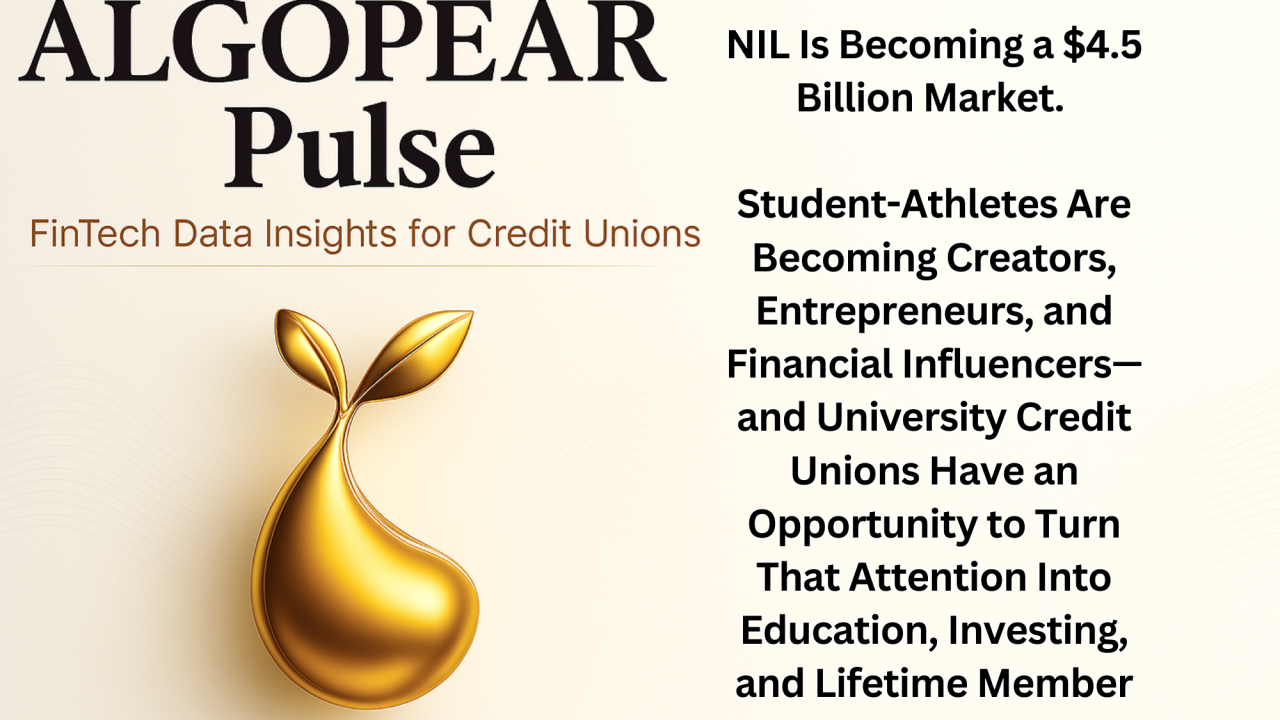
Name, Image, and Likeness has evolved far beyond the early days of local endorsement deals and one-off social-media promotions. Opendorse now estimates that the NIL market will reach approximately $4.5 billion during the 2026–27 academic year, a sharp increase from its previous estimate of $2.8 billion. Opendorse attributes that expansion in part to the emergence of a much broader commercial market surrounding athlete compensation, sponsorships, creator partnerships, collectives, and revenue-sharing structures. The significance for financial institutions is not simply the size of the number. It is the speed at which an entirely new economic layer has formed around college athletics. (Opendorse)
Student-athletes now occupy a position that barely existed several years ago. They are competitors, but many are also creators, entrepreneurs, brand representatives, community leaders, and digital publishers with direct relationships to large audiences. Their influence can extend well beyond the stadium. A student-athlete may communicate with thousands of students, alumni, fans, local residents, and prospective members through social media every week. That gives them something most financial institutions spend heavily trying to acquire: attention from highly specific communities delivered through a trusted human voice. NIL has therefore become more than a compensation framework. It has created a new distribution channel connecting brands with younger consumers through people they already know and follow.
For university-affiliated credit unions, this should be especially compelling. These institutions already operate within the same communities where NIL activity is accelerating. They serve faculty, employees, alumni, students, athletic departments, and surrounding populations. Yet much of the financial-services participation in NIL continues to be viewed through the traditional sponsorship lens: place a logo on content, associate the brand with an athlete, generate impressions, and hope awareness eventually converts into accounts. That approach captures only a fraction of the opportunity. NIL can become something much more valuable—a bridge between influence and financial education, between campus engagement and responsible investing, and ultimately between a student’s first financial decisions and a relationship that can continue for decades after graduation.
Student-Athletes Are Becoming One of the Most Powerful Financial Distribution Channels on Campus
Financial institutions have historically relied on branches, advertisements, direct mail, email campaigns, and increasingly digital acquisition to reach younger members. The challenge is that young consumers are surrounded by financial marketing and increasingly skeptical of traditional advertising. A message from an institution explaining the importance of saving or investing may be useful, but it competes with thousands of other messages for attention. A student-athlete speaking authentically about receiving their first meaningful income, learning to budget, preparing for taxes, or beginning to invest can make those same financial concepts far more relatable.
This does not mean student-athletes should become unqualified financial advisers or promote investments they do not understand. In fact, a responsible NIL strategy should establish exactly the opposite boundary. The athlete creates the introduction and cultural relevance; the financial institution provides the education, disclosures, regulated infrastructure, and responsible guidance. A basketball player could share why learning about budgeting became important after receiving NIL income. A football player could introduce an educational series on saving and taxes. An athlete from an Olympic sport could document the process of setting a first investment goal. The power comes from making financial progress visible and human, not from turning athletes into stock promoters.
That distinction allows credit unions to use NIL differently from many consumer brands. A beverage company may partner with an athlete to create awareness and drive short-term purchases. A credit union can create a multi-year financial-development relationship. The athlete introduces students to the institution, but the experience continues through financial education, savings goals, credit-building resources, direct investing, and personalized financial guidance. The marketing interaction becomes the entrance to an ecosystem rather than the end of the campaign. That is how NIL can move from an advertising expense to a genuine member-acquisition and engagement strategy.
The Athletes Earning NIL Income Need Financial Infrastructure Too
The NIL economy has created an entirely new financial reality for student-athletes themselves. Some are receiving modest payments from local partnerships, while others are managing substantial income from brands, collectives, appearances, social content, and other opportunities. Regardless of the amount, these young adults may suddenly face financial responsibilities that many students have never encountered: taxes, irregular income, contract payments, budgeting, saving, credit management, and decisions about what to do with earnings that may not continue indefinitely.
That creates an important role for university credit unions. NIL income should not simply pass through an account before being spent. Athletes can be taught how to create emergency reserves, prepare for tax obligations, manage unpredictable cash flow, avoid lifestyle inflation, understand credit, and begin building long-term assets while they have the opportunity. For many athletes, a playing career will end at graduation. Even among elite competitors, professional sports is far from guaranteed. The most valuable financial outcome of an NIL opportunity may therefore not be what an athlete earns during college, but how much of that income they successfully convert into long-term financial security.
Direct investing can become a responsible part of that strategy. An athlete earning NIL income could automatically allocate percentages toward taxes, cash reserves, near-term spending, and long-term investing. Rather than allowing an unusually high-income period to become a temporary lifestyle increase, the institution can help the student build assets that remain after the endorsements stop. The message is powerful: your name, image, and likeness may generate income today, but financial discipline can allow that income to create ownership for the rest of your life.
The Larger Opportunity Is Reaching the Students Who Follow Them
The NIL conversation often focuses primarily on the athletes receiving compensation, but the larger strategic opportunity may be the audience surrounding them. A popular student-athlete can influence thousands of other students who may never receive an NIL payment themselves but are making many of the same first financial decisions. They are opening checking accounts, earning income from internships or part-time jobs, applying for credit, managing student expenses, and beginning to think about investing.
Imagine an athlete participating in a campus-wide financial-wellness initiative rather than simply appearing in an advertisement. Students could follow a series explaining how to build an emergency fund, understand credit scores, begin investing with small amounts, learn the difference between stocks and ETFs, and establish long-term goals. Each piece of content could connect naturally to an experience inside the university-affiliated credit union, allowing students to learn and immediately take responsible action. Suddenly, NIL is not merely reaching an audience. It is activating one.
That can dramatically change the economics of a partnership. The value of the athlete is no longer measured only by views or social-media engagement. It can be measured through educational participation, new student memberships, savings goals created, first investment accounts, financial-wellness engagement, and long-term relationship retention. A credit union can begin connecting brand investment to meaningful financial outcomes. The student-athlete generates attention, but the institution converts that attention into measurable progress for the community.
Self-Directed Investing Gives NIL Engagement Somewhere Meaningful to Go
Many NIL campaigns ultimately lead consumers to a website, promotional offer, or product page. Financial institutions have an opportunity to create a more consequential destination. A student who becomes interested in financial education through an athlete partnership can move directly into a responsible wealth-building experience. They can learn what ownership means, understand basic market concepts, create an investment goal, and begin with a modest amount rather than being sent to an outside brokerage to continue the journey.
Self-directed investing is particularly relevant because it allows education and action to exist together. A student who learns about exchange-traded funds can explore them immediately. Someone learning about diversification can see how different assets behave inside a portfolio. A student beginning with five or ten dollars can develop familiarity with market movements without believing that investing requires significant wealth. The objective is not to generate trading volume. It is to make long-term financial participation accessible enough that students can begin learning through experience.
This is where the credit union can distinguish itself from a conventional brokerage platform. The investing experience can sit alongside budgeting, savings, credit education, financial wellness, and future lending. Members can receive guidance reminding them that emergency savings and high-interest debt matter before aggressive investing. They can understand risk rather than simply seeing returns. An NIL campaign brings the student into the conversation, but the credit union gives that conversation a responsible financial destination.
University Credit Unions Already Own the Community Advantage
National financial brands are spending aggressively to build relevance inside college athletics because they understand the cultural power of universities and sports. Credit unions affiliated with those universities often begin with something much harder to purchase: authentic community presence. They may have served employees, faculty, alumni, and students for generations. Their name may already be connected with campus life, local employment, athletics, and the broader university identity.
That gives these institutions an opportunity to create NIL strategies that feel less like advertising and more like community programming. A credit union can partner with athletes from multiple sports, including athletes whose smaller but highly engaged audiences may align strongly with particular student communities. It can build financial-education campaigns throughout the academic year, connect investing lessons with campus events, create workshops for NIL earners, and engage alumni in conversations about wealth building and financial mentorship.
Opendorse’s 2026 report emphasizes the growing value of athlete audiences and highlights commercial opportunities extending across college sports, including athletes beyond the most visible revenue-generating programs. Its dataset encompasses more than 200,000 athlete users and activity at nearly all NCAA, NAIA, and NJCAA member institutions, illustrating how broad the NIL creator economy has become. (Opendorse) For credit unions, that means the opportunity is not reserved for institutions associated with national championship programs. NIL strategies can be built around relevance, community, and engagement rather than simply the most expensive athlete available.
NIL Can Become a Member-Acquisition Strategy With a Much Longer Time Horizon
The economics of acquiring a college student are different from acquiring an established consumer with a mortgage, retirement account, and significant deposits. A student may initially bring limited balances and relatively little immediate revenue. That can cause institutions to undervalue the relationship. But the financial lifetime ahead of that student is enormous. The individual may soon graduate, enter a professional career, purchase a vehicle, finance a home, invest for retirement, establish a business, start a family, and accumulate significant financial assets.
An NIL partnership can help the credit union enter that relationship before competitors do. A student discovers the institution through an athlete they follow, participates in financial education, opens an account, begins saving, and perhaps makes a first investment. Over four years, the credit union becomes associated with financial progress rather than simply campus transactions. When graduation arrives, the relationship does not need to end. It can evolve into direct deposit, larger investment contributions, auto lending, credit products, mortgages, and eventually more sophisticated wealth services.
This is why NIL should be evaluated through lifetime member value rather than campaign impressions alone. A sponsorship generating thousands of social views may be useful. A strategy converting a portion of those viewers into financially engaged members who remain with the institution for twenty or thirty years can be transformational. The goal is not merely to capture attention during a sports season. It is to use that attention to begin relationships at one of the earliest and most valuable points in a member’s financial life.
The Best NIL Strategy Connects Influence to Financial Wellness
There is also an important responsibility attached to this opportunity. NIL is creating new income and commercial possibilities for young adults who may have limited experience managing money. Financial institutions should not treat that vulnerability as an opportunity to push investment products or aggressive borrowing. Credit unions can instead become the responsible infrastructure surrounding the NIL economy.
A comprehensive strategy might begin with income management and taxes, move into emergency savings and credit education, introduce investing only after foundational concepts are understood, and eventually connect members with long-term goals. Athletes themselves can participate in that journey publicly in ways that make financial learning more relatable to peers. They are not presenting themselves as experts; they are demonstrating that becoming financially capable is a process.
This aligns naturally with the credit union mission. The institution helps members build confidence, not simply consume products. It helps NIL earners convert temporary income into lasting assets. It helps students who follow those athletes understand ownership and compound growth. It turns influence into education and education into action. Done correctly, NIL becomes a mechanism for extending financial wellness across an entire campus community.
The $4.5 Billion NIL Economy Is Already Moving. Credit Unions Need a Strategy Before the Relationships Are Gone
The NIL economy is scaling rapidly. Opendorse’s revised estimate of $4.5 billion for 2026–27 is roughly 61% higher than the firm’s earlier forecast, demonstrating just how quickly the market has evolved. (Opendorse) Brands, agencies, universities, collectives, athletes, technology companies, and new commercial platforms are already building around this opportunity. Athlete audiences are increasingly treated as valuable creator inventory, while entirely new businesses are emerging to organize NIL partnerships and help brands navigate the market. (The Wall Street Journal)
Credit unions should not view this as another trend they can observe indefinitely. Every NIL partnership established by another financial brand creates an opportunity for that competitor to begin influencing students before the credit union relationship becomes fully developed. Every athlete who introduces a fintech app, payment platform, investment service, or national financial brand to their audience can accelerate the formation of relationships that may continue well beyond college.
At AlgoPear, we believe credit unions can approach NIL differently. Through Selene Intelligence, institutions can connect student-athlete influence with financial education, self-directed investing, AI-powered guidance, and a broader wealth-building experience designed for young members. The athlete creates the attention. The credit union provides the trust. Investing creates participation. Education creates confidence. Together, those elements can transform NIL from a marketing tactic into a genuine financial-development ecosystem.
The opportunity is much larger than putting a logo next to an athlete.
NIL creates influence. Credit unions can turn that influence into ownership.
And the institutions that begin those relationships on campus may still be serving those members decades after the final whistle.
Subscribe to AlgoPear Pulse
College athletics is rapidly becoming one of the most important laboratories for the future of financial engagement. NIL, direct investing, financial education, artificial intelligence, and creator-driven distribution are creating new ways for credit unions to reach younger members and build relationships before financial habits become permanent.
Subscribe to the AlgoPear Pulse Newsletter for weekly executive perspectives on credit union innovation, WealthTech, NIL, direct investing, fintech competition, lending strategy, and the future of intelligent financial ecosystems.
Visit AlgoPear.com to learn how AlgoPear and Selene Intelligence are helping credit unions connect financial education, investing, AI-powered guidance, and member engagement into wealth-building experiences designed for the next generation.